
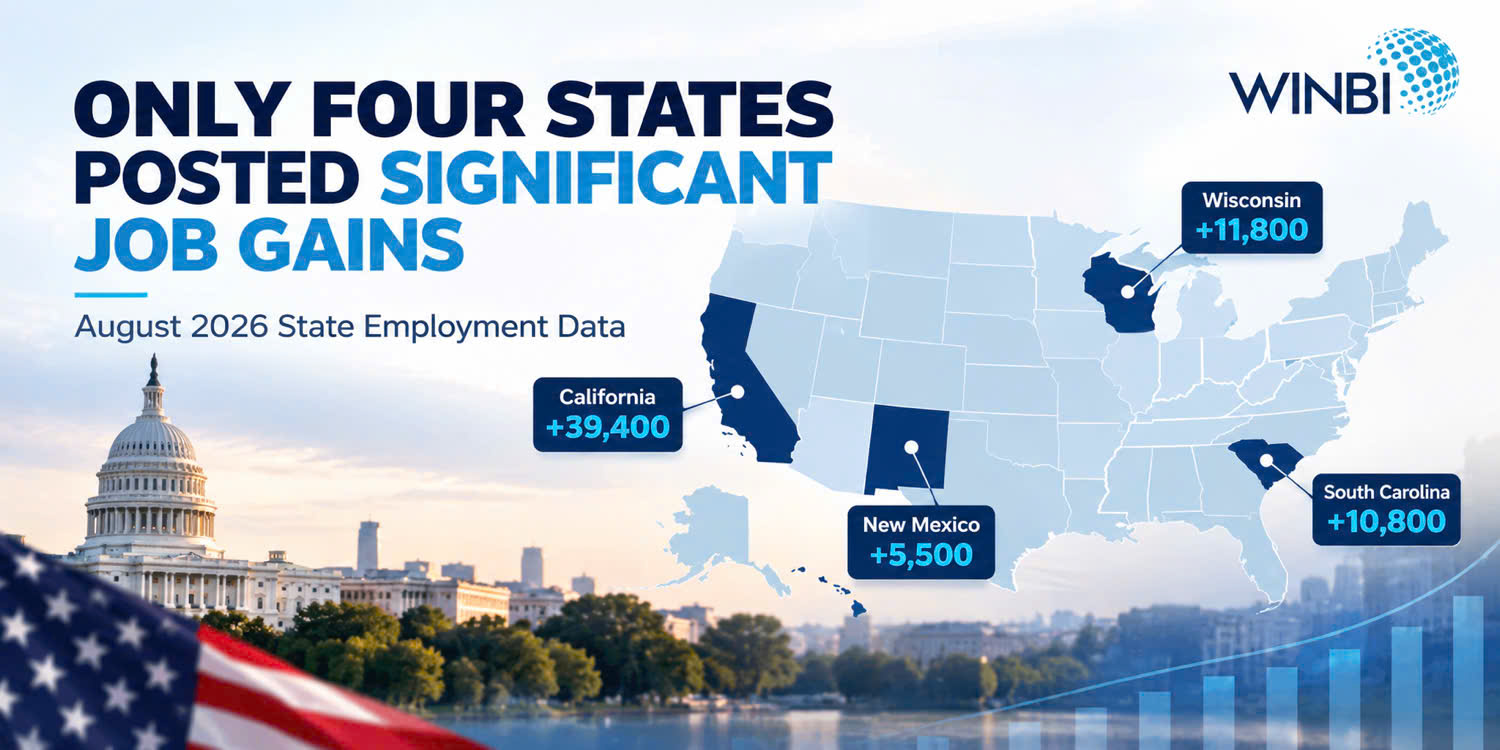
The August state employment data illustrates that difference.
According to the U.S. Bureau of Labor Statistics (BLS), nonfarm payroll employment increased significantly in only four states in August 2026: California, which added 39,400 jobs; Wisconsin, 11,800; South Carolina, 10,800; and New Mexico, 5,500. Employment was essentially unchanged in the other 46 states and the District of Columbia. Nationally, the unemployment rate remained at 4.1 percent.
Those numbers provide useful context, but they do not tell an employer whether a particular position will be easy to fill. For workforce planning, the more relevant question is what the labor market looks like where the business is actually hiring and whether that market can support its workforce needs over time.
Employers Hire in Local Labor Markets
A national unemployment rate says little about the hiring conditions facing a particular employer.
A restaurant operator in South Carolina, a manufacturer in Wisconsin, and a healthcare provider in another state may all be hiring at the same time, but they are not competing in the same labor market. Even businesses in the same industry and state can face different hiring conditions depending on occupation, location, wages, turnover, commuting patterns, and competition for workers.
Relatively flat employment at the state level should not be interpreted as evidence that workers are readily available.
For an individual employer, internal hiring patterns often provide more useful information. How long are important positions staying open? Are the same jobs being recruited for every few months? Has overtime become a regular response to vacancies? Are managers spending more time covering schedules or recruiting for positions they thought they had already filled?
When those issues repeat, they begin to look less like isolated recruiting problems and more like workforce capacity issues.
Look at the Pattern, Not One Month
No single monthly employment report should determine a company’s workforce strategy. The value comes from looking at labor-market data alongside what the business is experiencing over time.
Turnover, time-to-fill, compensation, applicant volume, retention, overtime, and repeated vacancies can reveal patterns that a headline employment number cannot.
Growth plans add another dimension.
A company may be adequately staffed for its current operation but still be unprepared for what comes next. A new location, an additional production line, an expanded service area, or another shift can create workforce demand well before those jobs formally become vacancies.
If a business expects to add employees next year, the workforce question starts well before those positions appear on a job board.
Where will those workers come from? How long does it typically take to recruit and train them? Are the same occupations already difficult to fill? Does the current recruiting model have enough capacity to support the planned growth?
These are workforce planning questions, not simply recruiting questions.
Planning Before the Position Opens
For employers looking ahead to 2027 and beyond, workforce planning should account for both current hiring conditions and future workforce demand.
There is no single strategy that applies to every employer. Depending on the business and the positions involved, the answer may include stronger retention efforts, compensation adjustments, training and internal career pathways, broader recruiting channels, cross-training, scheduling changes, or a combination of several approaches.
For businesses with recurring needs for permanent, full-time employees, international recruitment may also be part of that discussion.
Employment-based immigration programs such as EB-3 can be relevant for certain permanent positions, but the process operates on a much longer timeline than ordinary recruiting. It is therefore better considered as part of advance workforce planning rather than as a response to an immediate vacancy.
An employer facing an open shift today still needs an immediate recruiting solution. Long-term workforce planning addresses a different question: What positions is the business likely to need consistently in the years ahead, and how early should it begin preparing for them?
Starting with the workforce need, rather than starting with an immigration program, leads to a more useful planning conversation.
What the August Data Can Tell Employers
The August report does not tell an individual employer whether it has a labor shortage, nor does it prescribe a hiring strategy.
What it does show is why national labor-market headlines should be treated as context rather than a complete picture of workforce availability.
State and local employment trends, industry conditions, turnover, time-to-fill, compensation, demographic changes, and planned business growth all contribute to a more practical assessment of workforce capacity.
For employers, the value is in watching how those indicators interact with what is happening inside the organization.
A vacancy is easy to see. A recurring workforce pattern develops more gradually, appearing through positions that repeatedly reopen, overtime that becomes routine, managers spending more time on coverage, or growth plans that depend on workers the business has not yet figured out how to recruit.
Recognizing those patterns early gives employers more time to decide which workforce strategies make sense before the next position opens.
Source: U.S. Bureau of Labor Statistics, State Employment and Unemployment — August 2026, released September 18, 2026.
This article is for general informational purposes only. Employment-based immigration requirements and timelines may vary depending on the employer, position, and individual circumstances.